
The Confusion That Costs Businesses Real Money
Brand hierarchy and brand architecture are two of the most frequently conflated concepts in business strategy. Marketing teams, executives, and even some consultants use the terms interchangeably, treating them as synonyms for the same idea. They are not. This confusion is more than a semantic problem. It leads to misaligned strategies, wasted resources, and brand portfolios that underperform because the wrong framework was applied to the wrong problem.
Understanding the distinction between brand hierarchy and brand architecture is essential for making sound strategic decisions about how your brands are organized, how they relate to each other, and how they collectively create value in the market. This article provides clear definitions, a side-by-side comparison, real-world application guidance, and practical steps for determining which framework your business needs to prioritize. (For the related and equally confused pairing, see our guide to brand strategy vs brand architecture and which one to build first.)
Brand Architecture: Definition and Scope
Brand architecture is the overarching strategic framework that defines the structure, roles, and relationships of all brands within a business portfolio. It is a strategic planning tool that determines how brands are organized to maximize market coverage, minimize internal competition, and create the greatest possible value for the business.
A brand architecture framework answers fundamental strategic questions:
- How many brands does the business need to serve its target markets effectively?
- What role does each brand play in the overall portfolio strategy?
- How should brands relate to each other to maximize collective value?
- Where should the business invest brand-building resources for the greatest return?
- How should new products, services, or market entries be branded?
Brand architecture operates at the strategic level. It is concerned with portfolio-wide decisions that affect how the entire business goes to market. The brand architecture definition encompasses not just the structure itself but the strategic logic behind it: why brands exist, what purposes they serve, and how they contribute to business objectives.
There are several established brand architecture models that businesses adopt:
- Branded house: A single master brand extends across all products and services. The corporate brand is the primary identifier, and individual offerings are presented as variations of the master brand. This model maximizes brand equity transfer and simplifies marketing but limits the ability to target distinct market segments with differentiated positioning.
- House of brands: Each product or business unit operates under its own distinct brand with minimal visible connection to the parent company. This model allows maximum market segmentation and independent positioning but requires significantly more marketing investment and prevents equity transfer between brands.
- Endorsed brands: Sub-brands maintain their own distinct identities but carry an endorsement from the parent brand. This hybrid model balances independence with credibility transfer, allowing differentiated positioning while leveraging the parent brand's reputation.
- Hybrid architecture: A combination of the above models applied across different parts of the portfolio based on strategic need. Most large organizations operate with hybrid architectures that use different models for different business units or market segments.
Brand Hierarchy: Definition and Scope
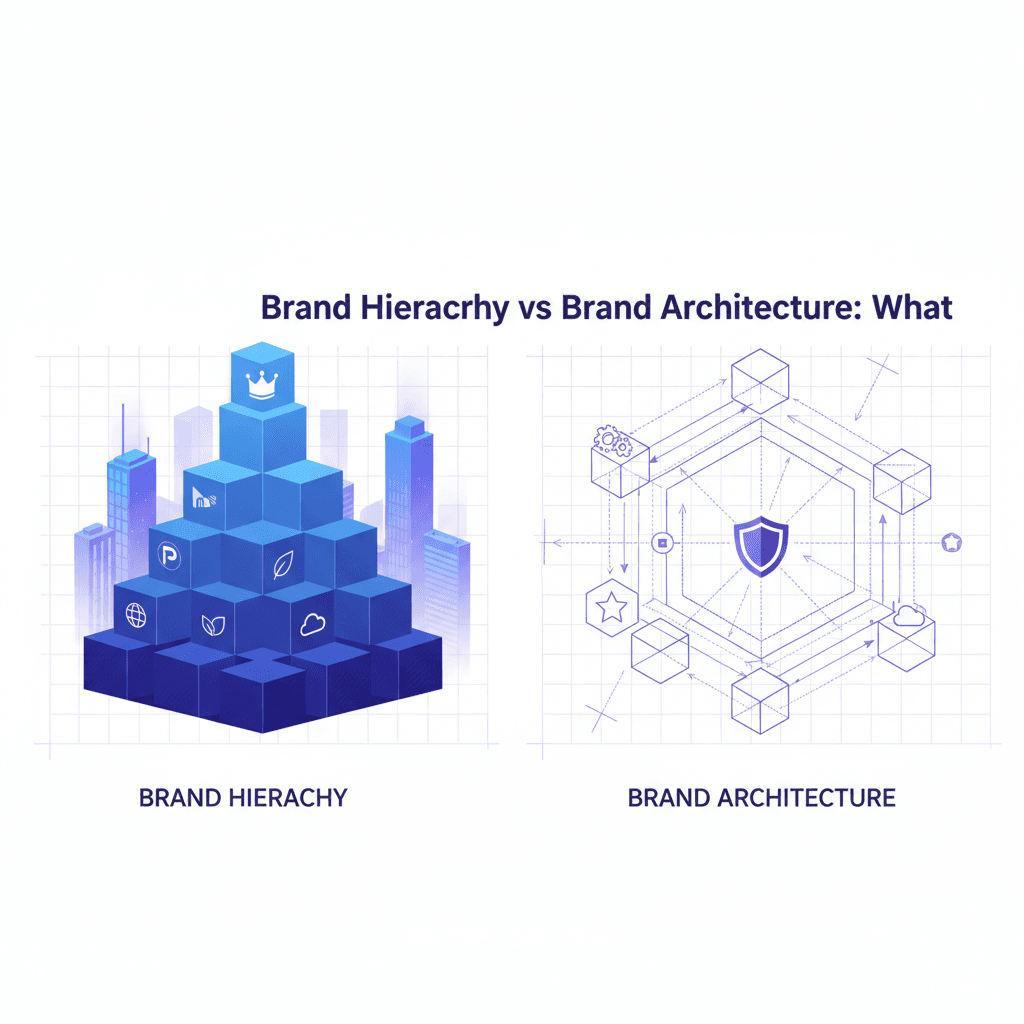
Brand hierarchy is the organizational system that defines the levels and layers within a brand portfolio, establishing which brands sit above, below, or alongside other brands. It is a structural tool that creates order and clarity within the portfolio by assigning each brand to a specific level in the organizational stack.
A typical brand hierarchy includes several distinct levels:
- Corporate brand: The highest-level brand that represents the entire organization. This is the brand that appears on legal documents, investor communications, and corporate-level marketing.
- Division or business unit brands: Brands that represent major business segments or divisions within the organization. These may or may not be visible to end customers depending on the brand architecture model.
- Product or service brands: Brands attached to specific products, product lines, or service offerings. These are typically the brands that customers interact with most directly.
- Sub-brands and variants: Brands that represent specific versions, editions, or variations of a product or service brand. These add specificity to the portfolio without requiring entirely new brand identities.
- Feature or ingredient brands: Brands attached to specific features, technologies, or components within a product. These exist to differentiate specific capabilities and can be shared across multiple product brands.
Brand hierarchy is primarily concerned with vertical organization: what sits above what, and how authority, equity, and visibility flow up and down the levels. It provides a clear map of where each brand sits in the organizational structure.
Side-by-Side Comparison
The following comparison table highlights the key differences between brand hierarchy and brand architecture across several critical dimensions. Understanding these differences is essential for applying the right framework to the right business challenge.
| Dimension | Brand Hierarchy | Brand Architecture |
|---|---|---|
| Primary focus | Vertical organization and levels within the portfolio | Strategic relationships and roles across the portfolio |
| Core question answered | Where does each brand sit in the organizational structure? | Why does each brand exist and how do brands create collective value? |
| Nature of the framework | Structural and organizational | Strategic and relational |
| Scope | Internal ordering of brand levels | Portfolio-wide strategy including market positioning and competitive dynamics |
| Decision type | Where to place a brand within existing levels | Whether a brand should exist, what role it plays, and how it relates to others |
| Orientation | Primarily inward-facing and organizational | Primarily outward-facing and market-oriented |
| Flexibility | Relatively rigid once established | Adaptable to market changes and strategic shifts |
| Key stakeholders | Brand managers, organizational leadership | C-suite, marketing leadership, business strategists |
| Change frequency | Changes with organizational restructuring | Evolves with market conditions and business strategy |
| Analogy | An organizational chart for brands | A strategic playbook for how brands win together |
When Brand Hierarchy Matters More
There are specific business situations where getting your brand hierarchy right is the more urgent priority. Focus on brand hierarchy when:
You Are Managing a Large Portfolio
Organizations with dozens or hundreds of brands need clear hierarchical structure to maintain operational order. Without a well-defined brand hierarchy, teams cannot determine which brands take priority in marketing, which brands should appear in which contexts, or how brand-level decisions escalate through the organization. A mid-size company that has grown from five products to fifty over a decade often discovers that the lack of hierarchical clarity is creating operational chaos: teams do not know which brand to lead with, which brand guidelines take precedence, or how to handle conflicts between brands at the same level.
You Need Internal Clarity
When different teams within your organization have different understandings of how your brands relate to each other, brand hierarchy provides the structural clarity needed to align everyone. It establishes clear reporting lines for brand decisions and ensures that every team member knows which level of the brand portfolio they are responsible for managing.
You Are Integrating Acquisitions
After acquiring new businesses, one of the first operational questions is where the acquired brands fit within your existing hierarchy. Establishing their level in the hierarchy is often a prerequisite for making broader architectural decisions about their long-term role and relationships.
You Need Governance Standards
Brand hierarchy supports governance by establishing clear rules about which brand levels have authority over which decisions. Corporate-level brand decisions follow different processes than product-level brand decisions, and the hierarchy defines those boundaries. Without hierarchical governance, brand decisions become ad-hoc and inconsistent.
When Brand Architecture Matters More
Brand architecture takes priority when the strategic questions about your brand portfolio are more important than the organizational ones. Focus on brand architecture when:
You Are Entering New Markets
Expanding into new geographic markets, customer segments, or product categories requires strategic decisions about how your brands should be structured to compete effectively. Should you extend your existing brand, create a new brand, or acquire a local brand? These are architecture decisions, not hierarchy decisions. The answer depends on competitive dynamics, customer expectations, and the strategic role each brand plays in your growth plan.
You Are Experiencing Cannibalization
When brands within your portfolio compete against each other for the same customers, the problem is architectural, not hierarchical. Your brands may be perfectly organized in the hierarchy but strategically redundant in the market. Solving cannibalization requires rethinking the strategic roles and relationships of the competing brands, which is fundamentally a brand architecture challenge.
Your Competitive Position Is Weakening
If your market share is declining despite strong operational execution, the issue may be that your brand portfolio structure does not match the competitive landscape. Brand architecture analysis reveals whether you have the right brands, in the right roles, targeting the right segments to compete effectively. A company that once dominated its market with a single branded house approach may discover that competitors using a house of brands strategy are capturing niche segments that the master brand cannot credibly serve.
You Are Planning a Major Strategic Shift
Business transformations, pivots, and major strategic changes almost always require brand architecture review. The brand portfolio structure that supported your previous strategy may actively hinder your new direction. Architecture decisions made during strategic transitions have outsized impact on the success of the transformation.
How Brand Hierarchy and Brand Architecture Work Together
Despite their differences, brand hierarchy and brand architecture are not opposing frameworks. They are complementary tools that address different aspects of brand portfolio management. The most effective brand strategies use both frameworks in coordination.
Think of it this way: brand architecture is the strategic blueprint that determines what your brand portfolio should look like and why. Brand hierarchy is the organizational framework that implements that blueprint by assigning each brand to its proper level and establishing clear structural relationships.
Here is how they work together in practice:
- Architecture sets the strategy: Brand architecture decisions determine how many brands you need, what role each brand plays, and how they should relate to each other in the market. These are the strategic decisions that shape your portfolio.
- Hierarchy implements the structure: Once the architectural decisions are made, brand hierarchy organizes the brands into a clear structural framework that defines levels, reporting relationships, and governance rules.
- Architecture drives market positioning: The brand architecture determines how customers experience the portfolio, which brands are visible, which are endorsed, and which operate independently. This is the outward-facing expression of your portfolio strategy.
- Hierarchy drives operational management: The brand hierarchy determines how brand assets are managed, who has decision-making authority at each level, and how brand standards are maintained across the organization.
- Architecture evolves with markets: As competitive dynamics change and new opportunities emerge, brand architecture adapts to ensure the portfolio remains strategically sound.
- Hierarchy evolves with organization: As the business grows, restructures, or acquires new entities, the brand hierarchy adjusts to maintain organizational clarity.
Brand architecture without hierarchy creates strategic vision with no organizational backbone. Brand hierarchy without architecture creates organizational order with no strategic direction. Effective brand management requires both.
Common Confusion Points
Several specific areas of confusion frequently arise when teams discuss brand hierarchy and brand architecture. Clarifying these points prevents costly misunderstandings.
Confusion 1: Assuming Hierarchy Equals Strategy
The most common mistake is treating the hierarchical arrangement of brands as a strategic plan. Placing brands in a neat organizational chart does not answer whether those brands should exist in the first place, whether they are positioned correctly in the market, or whether their relationships create or destroy value. A perfectly organized hierarchy of poorly conceived brands is still a failing brand portfolio.
Confusion 2: Using Architecture Terms for Hierarchy Decisions
Teams sometimes use brand architecture terminology when they are actually making hierarchy decisions. For example, debating whether a new product should be a "sub-brand" or a "product brand" is often a hierarchy question about level placement, not an architecture question about strategic role. The architecture question is whether the product needs its own brand at all or should simply be a variant of an existing brand.
Confusion 3: Treating Branded House vs House of Brands as Hierarchy Models
The branded house versus house of brands distinction is an architecture decision about strategic relationships, not a hierarchy decision about organizational levels. A branded house has a hierarchy, and a house of brands has a hierarchy. The hierarchy exists within any architecture model. Confusing the architecture model with the hierarchical structure leads to portfolio decisions that solve the wrong problem.
Confusion 4: Assuming One Framework Is Sufficient
Some organizations believe they only need brand hierarchy or only need brand architecture. In reality, every brand portfolio of meaningful size needs both. Small businesses with a single brand may be able to defer the hierarchy conversation, but any business with multiple brands, product lines, or market segments needs both frameworks operating in coordination.
Confusion 5: Conflating Visual Hierarchy with Brand Hierarchy
Visual hierarchy, the arrangement and prominence of brand elements in design and communications, is related to but distinct from brand hierarchy. Visual hierarchy is a communication tool that expresses the brand hierarchy through design. Changing the visual hierarchy does not change the brand hierarchy, and changing the brand hierarchy requires corresponding updates to the visual hierarchy to remain coherent.
How to Evaluate Which Your Business Needs to Focus On
If you are unsure whether your business needs to prioritize brand hierarchy or brand architecture work, use the following diagnostic questions to guide your decision.
Prioritize Brand Hierarchy If:
- Teams within your organization disagree about where specific brands sit in the portfolio structure.
- You lack clear governance rules for who can make brand decisions at each level.
- Brand management responsibilities overlap or have gaps between teams.
- You have recently acquired new brands and need to integrate them into your existing structure.
- Internal brand documentation is inconsistent about the relationships between brand levels.
Prioritize Brand Architecture If:
- Customers are confused about the relationships between your brands in the market.
- Your brands are competing against each other for the same customers.
- You are entering new markets and need to decide how to brand your entry.
- Your marketing ROI is declining despite consistent execution quality.
- You cannot clearly articulate the strategic role each brand plays in your portfolio.
- Competitors with different portfolio structures are outperforming you.
Address Both Simultaneously If:
- You are undergoing a major business transformation or strategic pivot.
- You have never formally defined either your brand hierarchy or brand architecture.
- Both internal confusion and market confusion exist in significant measure.
- You are planning a comprehensive rebrand or brand portfolio restructuring.
In many cases, the right answer is to start with brand architecture because it establishes the strategic foundation that the hierarchy then implements. Getting the architecture right first ensures that the hierarchy you build serves a clear strategic purpose rather than simply organizing brands for the sake of organizational neatness.
Moving from Clarity to Action
Understanding the distinction between brand hierarchy and brand architecture is the first step. The second step is assessing your current state across both frameworks and identifying where the gaps are creating the most significant business impact.
Start by documenting your current brand hierarchy. Map every brand to its level in the portfolio and identify any brands whose level placement is unclear or disputed. Then assess your brand architecture by defining the strategic role each brand plays and evaluating whether the relationships between brands are creating or destroying value.
Where you find the greatest gaps between your current state and your desired state, that is where your investment should focus first. Brand portfolio structure is too important to leave to chance or to organic evolution. The businesses that deliberately design both their brand architecture and brand hierarchy consistently outperform those that let these frameworks develop ad-hoc over time.
Whether your immediate priority is hierarchy, architecture, or both, the key insight is the same: these are distinct strategic tools that serve different purposes, and using the right tool for the right problem is the foundation of effective brand portfolio management.