
A client asks for a CFO agent. Or a marketing analyst, or a reporting workflow, or something to handle the first pass of client service. The request is always about the output. But before any of those systems can do useful work, somebody has to answer a set of unglamorous questions: Where is the information? Which of these three versions is current? Who owns this number? How does it get maintained? And what should the system do when the answer just is not there?
I kept running into those questions in client work, and somewhere in each of those conversations a vocabulary problem shows up. The client says second brain. I say knowledge base. We circle each other for ten minutes before realizing we mean overlapping things. If you search "knowledge base vs second brain" you will find plenty of pages treating them as rival products, which misses what is actually going on.
Here is the distinction that finally made it click for me:
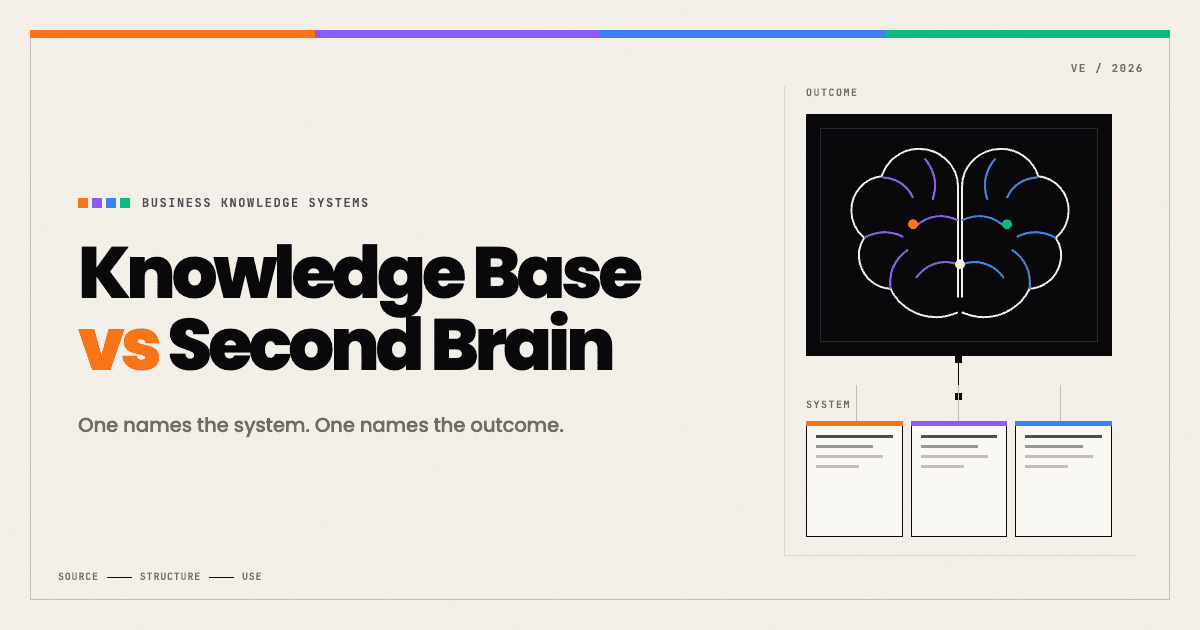
Second brain names the outcome. Knowledge base names the system.
A professional second brain is the client-facing result: one useful body of business context that people and AI can navigate, use, and maintain. A structured, maintained knowledge base is what sits underneath that result: the approved sources, the structure, the source-backed information, the retrieval tests, the ownership, and the handoff plan. Once that relationship is clear, you can stop policing the vocabulary and use whichever term fits the sentence.
Why the terms blur together
"Second brain" grew up in personal productivity. For most people it means a note-taking practice: capture what resonates, organize it lightly, retrieve it later. If that is the version you want, I wrote a separate practical guide to getting started with a second brain, and it is a genuinely good place to begin.
"Knowledge base," meanwhile, can mean a customer support center, an internal wiki, a shared drive with pretensions, or a structured business system feeding AI tools. Same word, four different artifacts.
So when a consultant tells a client "you need a knowledge base" and the client hears "help desk articles," or the client says "build me a second brain" and the consultant hears "note-taking hobby," both sides are working from the wrong picture. The fix is not a better glossary. It is being clear about which layer you are talking about: the outcome or the system.
What a second brain gets you
A second brain is best described by what it feels like to have one. Context can be recovered without starting from zero. You, your team, and your AI tools can pull up the relevant history before making a call. Decisions stay findable, along with the reasoning behind them. The thing supports real work, not just archiving. And it stays useful because someone maintains it.
Notice that none of that names an app. Notion is not a second brain. Obsidian is not a second brain. A folder of Markdown files is not a second brain either. Any of them can host one. The second brain is the condition you reach when the important context of a business is actually available at the moment of use.
What a knowledge base actually is
The knowledge base is the concrete machinery under that condition. When I build one for a client, the parts are boringly specific: registered sources someone approved, business information structured so it can be found, claims traced back to where they came from, decisions recorded next to the open questions that have not been decided yet, named ownership, access rules, retrieval tests, change history, and a maintenance routine with a handoff plan behind it.
A folder of documents is a completely valid starting point. I want to be direct about that, because people assume the professional version requires a vector database and an engineering team. It does not. The professional quality comes from the delivery discipline, not the stack. A plain folder with approved sources, honest unknowns, and a tested handoff beats an elaborate platform full of unowned, unattributed content every time.
Knowledge base vs second brain, side by side
| Second brain | Knowledge base | |
|---|---|---|
| What the term emphasizes | Use, retrieval, continuity: context available when needed | The concrete system: files, sources, structure, operating rules |
| Typical audience | The people and AI tools relying on the context | Whoever builds, owns, and maintains the system |
| Primary outcome | Work continues without re-answering old questions | Trustworthy, source-backed information that can be retrieved |
| Concrete components | None by itself; it depends on the system underneath | Approved sources, structured docs, decisions, ownership, change history |
| Quality test | Does the right context show up during real work? | Do retrieval tests pass, and does every claim trace to a source? |
| Maintenance requirement | Someone keeps it useful | Named owner, review cadence, change control, handoff plan |
Read the rows and you will see how much overlaps. Both need maintenance. Both live or die on retrieval. That is the point: these are two descriptions of one asset at different altitudes, not two products competing for a budget line.
A worked example: Northstar Operations
Abstract distinctions are cheap, so let me make it concrete. Northstar Operations is a fictional demonstration business I use for exactly this purpose. It is not a real client and it has no real performance results; it exists so we can look at the mechanics without anyone's confidential information on the table.
Northstar starts where every real client starts: knowledge scattered across a website, discovery-call notes, an offer document, a few operating principles someone wrote down in year two, decisions made in meetings nobody minuted, and a pile of open questions the founders carry in their heads.
Turning that into a knowledge base is unspectacular work. The website and call notes get registered as sources. The offer details get structured into their own documents with the source attached. The operating principles get written down properly. Decisions get recorded with dates and reasoning. The open questions get a page of their own, labeled as open, which matters more than it sounds.
Now put a workflow on top. Say Northstar wants a weekly client-report agent. Wired to the knowledge base, that agent can pull the current offer language instead of last year's, check what was already decided about a client before recommending it again, and flag when a question it needs answered is sitting in the open-questions file rather than inventing an answer. To the people receiving those reports, the whole thing behaves like a second brain: the business remembers itself.
The part I try hardest to land with clients is this: the workflow's own data can tell an agent what changed. Only the business knowledge can tell it whether the change matters. A metric moving 15 percent is a fact. Whether that is a fire, a seasonal ripple, or the intended result of a decision made in April lives in the knowledge base, or it lives nowhere.
What makes the professional version different
Everything above could describe a well-organized internal setup. The professional version, the kind you deliver to a client and walk away from cleanly, adds a delivery standard: claims backed by sources, unknowns stated explicitly, retrieval tested before handoff, ownership named, access boundaries set, changes controlled, maintenance scheduled, and a handoff that someone who was not in the room can actually receive.
The one that surprises people is the unknowns. In a professional system, "unknown" is sometimes the correct answer, and it takes discipline to leave it there. A knowledge base that refuses to invent an owner for a decision is more useful than one that produces a polished guess, because the guess gets repeated by every agent and every new hire that reads it. I would rather hand a client a system with twelve honest gaps than one with twelve confident fabrications.
None of this requires more technology. It requires treating the knowledge base like a deliverable with an acceptance test, instead of a pile of notes that happens to be tidy.
So which one do you build?
If you are building for yourself: start a small knowledge base around one body of work. One project, one client, one recurring question you keep re-answering. The second-brain feeling arrives on its own once retrieval starts working.
If you are delivering for a client: define the professional second-brain outcome first, in the client's terms, then build and test the knowledge-base system underneath it. And do not bite off the whole company. One team, one workflow, or one bounded business question is the right first scope. A small system that passes its retrieval tests earns the right to grow. A company-wide system that never ships earns nothing.
Either way, the next move is the same and it is small: pick one bounded body of knowledge, list its sources, and write down the first ten questions the system should be able to answer. That list is your first retrieval test, and it will teach you more about the real state of the knowledge than any tool decision will.
Common questions
Is a second brain a knowledge base?
Mostly, yes. A working second brain has a knowledge base underneath it. The terms emphasize different things: second brain describes the experience of having context available, knowledge base describes the system of sources, structure, ownership, and maintenance that makes the experience trustworthy.
Is Notion or Obsidian a second brain?
No single app is. Either can host one, and so can a plain folder of Markdown files. The second brain is the outcome; the app is just where the knowledge base lives. Pick the tool your team will actually maintain.
What should a business build first?
A small knowledge base around one bounded body of work: one team, one workflow, or one recurring question. Register sources, structure the information, record decisions and open questions, then test whether the right answers come back before expanding.
Can an AI agent use an existing knowledge base?
Yes, if it is in a form the agent can read, most simply plain text. What the agent does with it depends on the system's quality: current versions marked, claims sourced, unknowns honest. An agent reading a stale knowledge base produces confident answers built on the wrong facts.
What makes a knowledge base professional?
Delivery discipline, not technology: approved sources, source attribution, explicit unknowns, retrieval tests, named ownership, access boundaries, change history, maintenance, and a tested handoff.
