
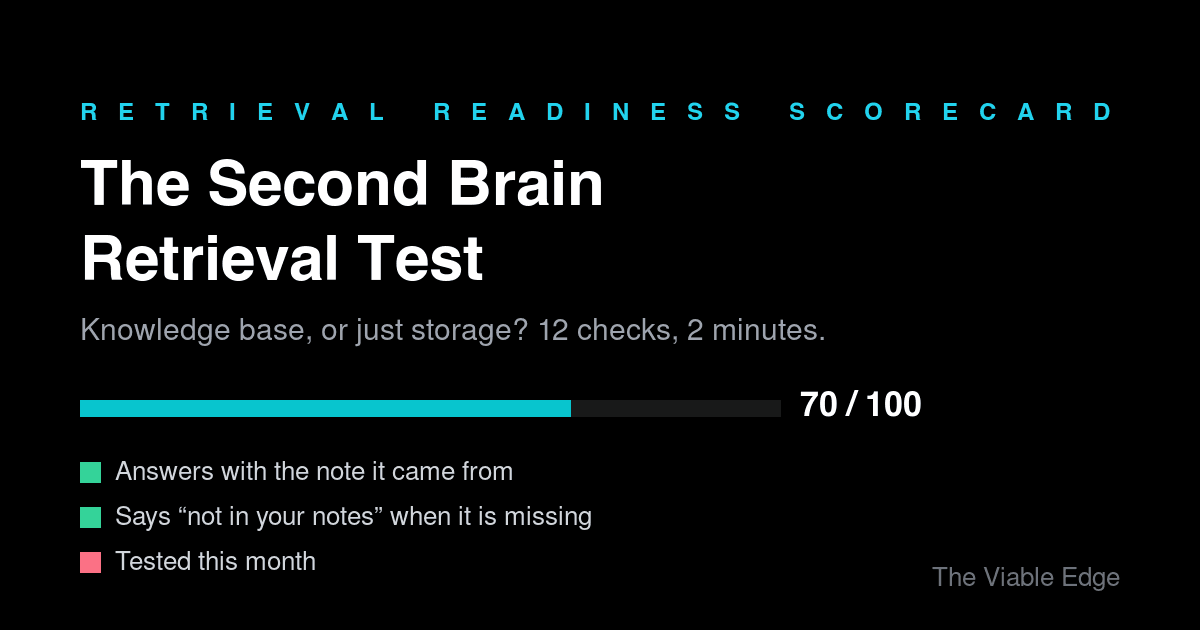
Here is the fastest way to find out whether your second brain actually works: ask it one real question your work depends on, and check two things. Did the answer come back with the note it came from, and would it have said "that is not in your notes" if the answer were missing? Pass both and you have a knowledge base. Fail either and you have storage: a place where notes go, not a system that answers. This guide is built around that test. It explains the four things retrieval actually requires, gives you an interactive scorecard that grades your system in about two minutes, and then shows you how to close whichever gaps it finds.
What is retrieval readiness?
Retrieval readiness is the standard a second brain has to meet before its answers can be trusted: it answers real questions without manual digging, every answer names the note or source it came from, questions it cannot answer produce an honest "unknown" instead of a fluent guess, and the whole thing is tested and maintained on a schedule. Storage holds notes. A knowledge base proves its answers.
Why most second brains fail silently
The uncomfortable truth about the second brain boom: most of the systems people built this year are write-only. Capture is the fun part, and the tools have made it nearly frictionless, so the folder grows. Growth feels like progress. But the folder was never the point. The point was the day you need the answer back, and that day exposes what the folder has quietly become.
The failure is silent because nothing about a storage system looks broken. The notes are there. Search sort of works. And now that everyone has pointed an AI assistant at their notes, the failure got quieter still, because the AI always answers. Ask it anything and fluent, confident prose comes back. Whether that prose came from your notes, from the model's general training, or from thin air is invisible unless your system is built to show you.
That is the trap worth naming plainly: a polished wrong answer is worse than silence. Silence sends you to go find the truth. A polished wrong answer gets pasted into the client email, the strategy doc, the invoice. Amateurs judge their second brain by how good the answers sound. Professionals judge it by whether an answer can name its source, and by what happens when the source does not exist.
The four pillars of a system that answers
Strip retrieval down and four properties carry all of it. These are the four pillars the scorecard below measures.
1. Retrieval: it answers real questions
Not "search returns results". Answers. You ask the question the way you would ask a colleague ("what did we decide about pricing in April?") and the system, usually an AI assistant reading your notes, comes back with the decision. If getting answers means you personally digging through folders, you do not have a retrieval layer; you are the retrieval layer, and the system's value caps at whatever you can remember about where things live.
2. Provenance: every answer names its source
An answer you cannot trace is an answer you cannot trust, and it definitely is not one you can hand to anyone else. Provenance is two habits: notes carry a source line (where it came from, when, and whether the words are yours or clipped), and your AI is instructed to name the note behind every answer. This is the cheapest discipline in the whole system, about two seconds per note, and it is the one that separates "sounds right" from "is right".
3. Honest unknowns: it can say "that is not in your notes"
This is the pillar almost nobody tests, and it is the sharpest one. Ask your system something you know your notes do not contain. The default behavior of every AI assistant is to answer anyway, fluently, from general knowledge or from nothing. A trustworthy system has a standing instruction that flips that default: answer from the notes, name the source, and when the source is missing, say exactly that and stop. "Unknown" is not a failure state. It is the system telling you precisely what to capture next.
4. Maintenance: it is tested and tended
Knowledge decays. Decisions get superseded, numbers go stale, and two notes end up disagreeing with the person who knew which was right long gone from the room. A system that stays true has a cadence: a short recurring pass that empties the inbox and archives the finished, and a monthly retrieval test where you ask it ten questions you know it holds and score the answers honestly. A second brain you never test is a second brain you cannot trust, and "I would find out if two notes disagreed" is a claim most systems fail.
Score your own system
The scorecard below turns those four pillars into twelve checks. Answer honestly (the only person you can cheat is you), and the score updates as you go. Two of the checks carry structural weight: a system that answers unknowns confidently and cites nothing gets capped in the Storage band no matter what else it does well, because that combination is the one that produces polished wrong answers. Your result shows exactly which checks failed and what fixes each one. No email is needed to see your score.