
The Viable Edge
About
Login
Let’s talk
Work with meSystems and implementationPrivate team workshopsIndividual mentorship
LearnSecond Brain CoursePublic Maven workshopBlogNewsletter
About
Digital productsClaude Code Service OSFind a Client Skill PackHermes First Handoff KitBrand ArchitectBrand Architect live demoBrand snapshot audit
Let’s talkLogin
  1. Home
  2. /
  3. Blog
  4. /
  5. How to Build a Knowledge Base for AI: A Second Brain It Can Read
How to Build a Knowledge Base for AI: A Second Brain It Can Read
ai-era-strategy8 min read

How to Build a Knowledge Base for AI: A Second Brain It Can Read

A knowledge base for AI is written so a model can find the right page, trust it and cite it. The build comes down to five steps: gather, split by topic, source every claim, assign owners and dates, then test retrieval with real questions. Here is each step, and what most teams get wrong.

AS

By Adam Sandler

Founder of The Viable Edge, with 20+ years of experience helping businesses build competitive advantage through strategic transformation. Expert in AI-era business strategy and systematic implementation.

Published October 19, 2026 · Updated October 19, 2026

To build a knowledge base for AI, write what you know as plain-text pages, one topic per page, with a source on every claim and an owner and review date on every page. Keep it in one folder an AI tool can read, then test it with questions people really ask. Structure and upkeep matter more than which AI you point at it.

Key takeaways

  • A knowledge base for AI is written for retrieval: one topic per page, so a model finds the right fragment.
  • Every claim needs a source, or the AI cannot tell a fact from an old draft.
  • Plain markdown in one folder is the most portable format; any current AI tool can read it.
  • Most small knowledge bases do not need RAG or a vector database at first.
  • Test with real questions, including two with no written answer, before anyone relies on it.

What is a knowledge base for AI?

A knowledge base for AI is a collection of your own facts, decisions and processes, written so an AI model can find the right part, trust it and cite it. It is the same knowledge a team already relies on, organized for a reader that retrieves fragments, remembers nothing between sessions and never asks a clarifying question.

People skim a long document and fill gaps from memory. A model does neither. It pulls the pages that look relevant to the question, answers from them, and fills any gap with a plausible guess. So the job of an AI knowledge base is to make the right page easy to find and the guess unnecessary.

For one person this is a second brain an AI can read. For a company it is an internal knowledge base. The build steps below are the same for both.

How is a knowledge base for AI different from a normal one?

The content is the same; the structure is stricter. Pages must be short and about one topic, because a model retrieves fragments. Claims need sources, because a model cannot judge which of two documents is current. Ambiguity costs more, because a model picks one reading and states it confidently instead of asking which one you meant.

Written for peopleWritten for AI
Page sizeLong guides are fineOne topic per page, so retrieval lands on the right one
SourcesOptional; readers know who wrote itRequired; the model needs a way to tell current from stale
GapsReaders ask a colleagueThe model guesses unless the page says "unknown"
FormatWhatever the wiki usesPlain text the tool can read without an export

We cover the brand and marketing version of these rules in what is a brand knowledge base.

How do you build a knowledge base for AI, step by step?

Gather the documents people already rely on into one place. Split them into one page per topic. Add a source line to every claim. Give every page an owner and a review date. Then test retrieval with ten real questions and fix the pages behind every wrong answer. Most teams can build a first version in days.

  1. Gather. Pull in the proposals, decks, docs and notes people already trust. Do not write anything new yet; you are collecting, not composing.
  2. Split by topic. One page per question area: an offer, a customer segment, a process, a decision. A 40-page deck becomes ten short pages a model can retrieve one at a time.
  3. Source every claim. A line saying where each fact came from lets a reader, or a model, check it and lets you find it again when it changes.
  4. Assign owners and dates. Every page gets a person and a review date. A page with neither is a guess that looks like a fact.
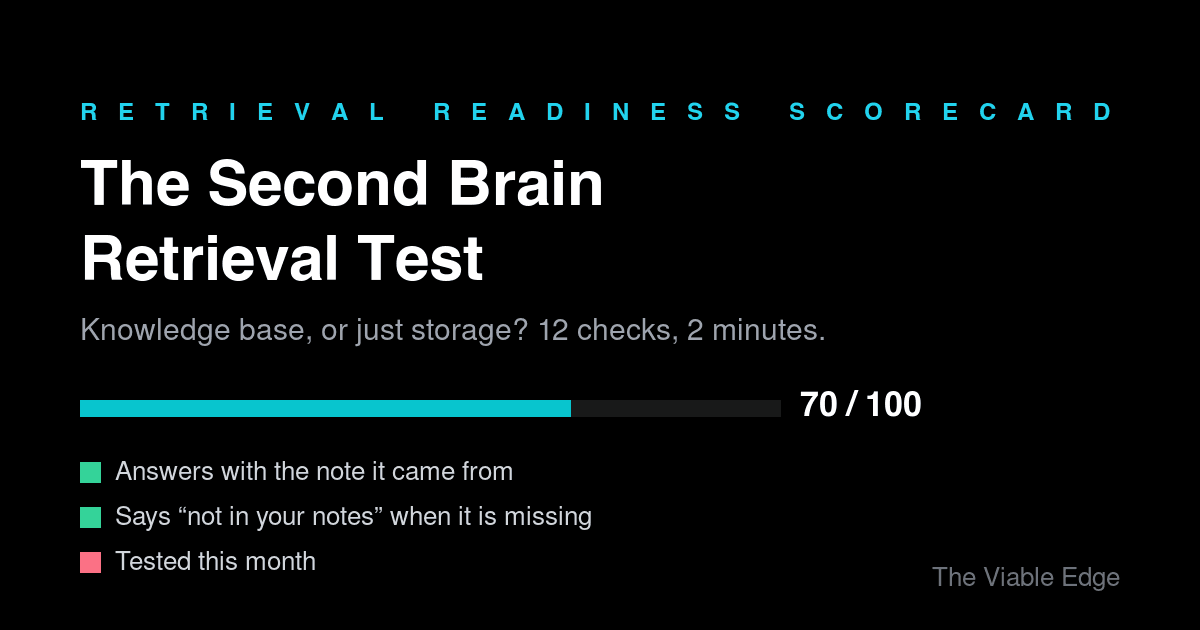
  5. Test retrieval. Ask the questions your team really asks and score the answers. Our retrieval test is a ten-question version with a scorecard.

The full personal setup, with folder structure and a weekly routine, is in our guide to building an AI second brain.

Free download

Start with the Second Brain Starter Kit

The capture inbox, note template, source log, weekly checklist, connect-your-AI guide and retrieval self-test, as plain markdown files that work in Obsidian or any editor, with Claude or any AI. Enter your email and the download starts.

No spam, ever
Unsubscribe anytime

What format should a knowledge base for AI use?

Plain markdown files in one folder are the most practical format today. Any editor opens them, every major AI tool reads them directly, and you never need an export. A short header on each page for owner, date and status helps the model judge freshness. Proprietary databases work too, as long as the AI can read them.

Markdown also keeps the knowledge base yours. If you change AI tools next year, the folder comes with you unchanged. That portability is why we build on files, and why open formats such as the Open Knowledge Format exist: markdown pages with a small YAML header, so different tools can read the same structure.

If your knowledge already lives in Notion, Confluence or a shared drive, you do not have to move it on day one. Check first whether your AI tool can read it, which we compare by tool type in AI knowledge management tools.

Do you need RAG or a vector database for an AI knowledge base?

Usually not at first. A few hundred well-split markdown pages fit comfortably in what tools like Claude Code or a Claude Project can search directly. RAG and vector databases earn their cost when the knowledge base grows into thousands of documents or many people query it at once. Structure first, retrieval infrastructure later.

Teams often start with the infrastructure because it feels like the technical part. The common result is a vector database full of duplicated, outdated documents that retrieves the wrong passage faster. A clean, sourced folder with no special retrieval layer usually beats a sophisticated pipeline over messy files.

We compare a compiled markdown wiki with RAG in more depth in LLM wiki.

How do you keep a knowledge base for AI accurate?

Give every page an owner who reviews it on a schedule, retire pages that no longer apply instead of leaving them, and rerun the same retrieval questions every month. When a score drops, fix the page behind the wrong answer. An AI knowledge base decays quietly, so the routine matters more than the first build.

A knowledge base that is wrong is worse than none, because the AI repeats its errors fluently. The fix is boring and reliable: a short weekly pass to file new material, a monthly retrieval test, and a named person for every section. Once that routine exists, every AI tool you connect gets better answers without any change to the tool.

For consultants and service providers

Build second brains for clients

Build and Deliver Professional Second Brains is a self-paced course on doing this for other people: scoping the engagement, building a knowledge base from a client's real material, testing retrieval, and handing it over, with a working knowledge base kit to build with. Plain files, no coding, no vector database.

Explore the course→

Related Articles

AI Knowledge Management Tools: From Second Brain to Company Wiki

The four types of AI knowledge tool, and which fits where your knowledge lives.

What Is an Internal Knowledge Base? A Second Brain for a Company

A company second brain: what goes in, and how to build one AI can use.

How to Build an AI Second Brain: The Practical 2026 Guide

One folder of plain-text notes, a capture habit, and an AI that reads it.

What Is a Brand Knowledge Base? The Marketing Knowledge Base Guide

The definition, what belongs in one, and how AI agents actually read it.

Work with The Viable Edge

Help your marketing team become AI-native.

Adam trains your team, redesigns the workflows, and builds the AI systems your team actually uses, starting from your real work.

Talk to AdamPrivate team workshopsThe course

Want the knowledge base built and kept current for you? Brand Architect does that. The first build is free, no credit card needed. Try Brand Architect →

The Viable Edge

Practical AI systems. Hands-on learning. Human judgment.

Work with me

Systems and implementationPrivate team workshopsIndividual mentorship

Learn

Second Brain CoursePublic Maven workshopBlogNewsletter

Digital products

Claude Code Service OSFind a Client Skill PackHermes First Handoff KitBrand ArchitectBrand Architect live demoBrand snapshot audit

Company

AboutWhy The Viable EdgeContactFAQKnowledge HubDevelopersLogin
© 2026 The Viable Edge. All rights reserved.
PrivacyTerms