
The Viable Edge
About
Login
Let’s talk
Work with meSystems and implementationPrivate team workshopsIndividual mentorship
LearnSecond Brain CoursePublic Maven workshopBlogNewsletter
About
Digital productsClaude Code Service OSFind a Client Skill PackHermes First Handoff KitBrand ArchitectBrand Architect live demoBrand snapshot audit
Let’s talkLogin
  1. Home
  2. /
  3. Blog
  4. /
  5. Personal Knowledge Management: A PKM System That Works With AI
Personal Knowledge Management: A PKM System That Works With AI
ai-era-strategy7 min read

Personal Knowledge Management: A PKM System That Works With AI

Personal knowledge management is the habit of capturing what you learn, organizing it, and getting it back when you need it. A PKM system has four parts: capture, organize, distill and retrieve. AI changes the last part most, which changes how the first three should be done.

AS

By Adam Sandler

Founder of The Viable Edge, with 20+ years of experience helping businesses build competitive advantage through strategic transformation. Expert in AI-era business strategy and systematic implementation.

Published October 26, 2026 · Updated October 26, 2026

Personal knowledge management (PKM) is the practice of capturing, organizing and reusing what you learn, so ideas and information are there when you need them. A PKM system has four parts: capture, organize, distill and retrieve. With AI, retrieval becomes asking questions of your own notes, so notes need to be short, sourced and in plain text.

Key takeaways

  • PKM is the practice; a second brain is the system you build to do it.
  • Every PKM system does four jobs: capture, organize, distill, retrieve.
  • Methods like PARA and Zettelkasten are ways of doing the organize step.
  • AI turns retrieval into conversation, which rewards short, sourced notes.
  • Plain text files in folders keep your PKM readable by any AI tool.

Free: the Second Brain Starter Kit

Seven plain markdown files to set one up this week, in Obsidian or any editor, with Claude or any AI.

No spam, ever
Unsubscribe anytime

What is personal knowledge management?

Personal knowledge management is how one person collects, organizes and reuses what they know: notes, articles, meeting takeaways, ideas and decisions. The goal is not storage. It is getting the right piece back at the moment you need it, so you stop relearning things and start building on them.

The term comes from management research in the late 1990s, as a personal counterpart to company knowledge management. It spread through note-taking communities in the 2010s, where it is usually shortened to PKM.

PKM covers the habits, not a specific app. Someone with a paper notebook and a weekly review practices PKM; someone with a thousand unread saved articles in a fancy tool does not.

What is the difference between PKM and a second brain?

PKM is the practice; a second brain is the system you build to carry it out. Tiago Forte popularized "second brain" as a name for a PKM system kept in digital notes. In everyday use the terms overlap, but PKM describes the discipline and second brain describes the result you can open and search.

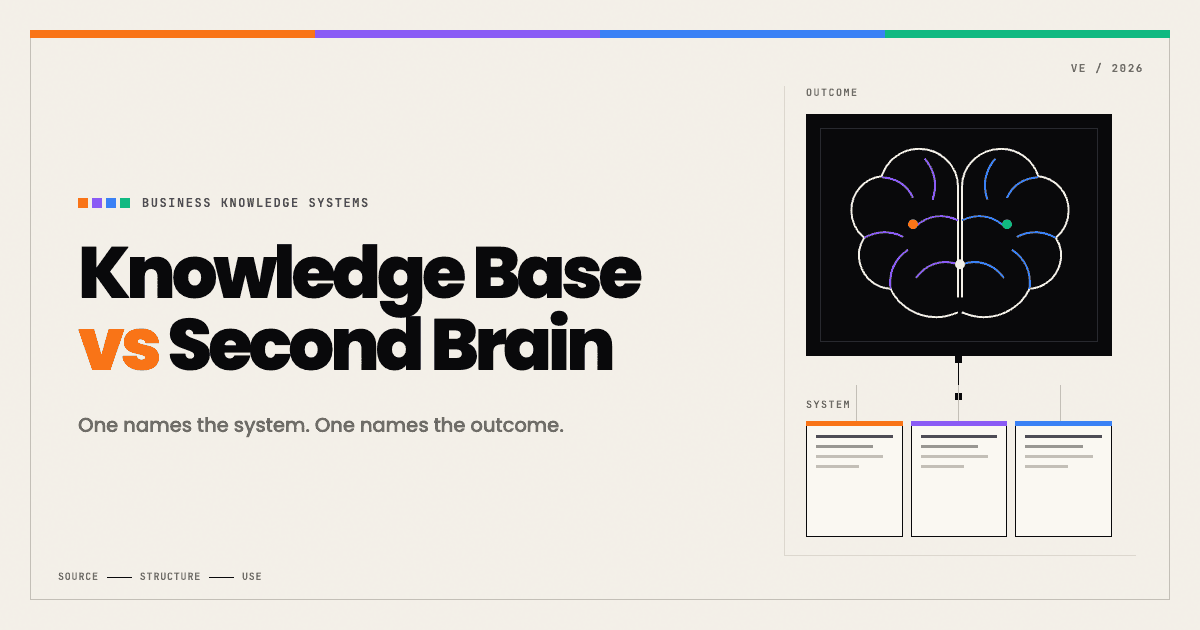
Other terms sit nearby. A personal knowledge base is the collection of notes itself. A team knowledge base is the shared version, owned by a company rather than one person; we compare the two in knowledge base vs second brain. For the second brain idea in full, start with what is a second brain.

What are the parts of a PKM system?

Every PKM system does four jobs. Capture: get ideas and sources out of your head and into one inbox. Organize: put each note where you will look for it. Distill: shorten notes to the part worth keeping. Retrieve: find and reuse notes when a task calls for them. Weak systems usually fail at retrieve.

StepWhat it meansCommon methods
CaptureOne inbox for everything worth keepingQuick notes, read-later, voice memos
OrganizePut notes where you will look for themPARA, Zettelkasten
DistillKeep the part that mattersProgressive summarization
RetrieveGet notes back when work needs themSearch, links, and now AI questions

These map closely to the CODE steps in Forte's book, covered in our Building a Second Brain summary.

Free download

Start with the Second Brain Starter Kit

The capture inbox, note template, source log, weekly checklist, connect-your-AI guide and retrieval self-test, as plain markdown files that work in Obsidian or any editor, with Claude or any AI. Enter your email and the download starts.

No spam, ever
Unsubscribe anytime

How does AI change personal knowledge management?

AI changes retrieval most. Instead of remembering where a note lives, you ask a question and the tool finds the passages that answer it. That only works when notes are short, about one idea, in your own words and sourced. Long mixed notes and content locked inside one app are what break AI retrieval.

Three adjustments make an existing PKM setup work with AI tools such as Claude or ChatGPT:

  • Plain text files. Markdown in ordinary folders can be read by any AI tool now and later. Content trapped in a proprietary database often cannot.
  • One idea per note, with a title that states the idea, so the passage the model finds is the full answer.
  • A date and a source on each note, so you can tell current from stale and check what the AI quotes.

To check whether your notes are ready, run our ten-question retrieval test.

What are the best PKM tools?

The best PKM tool is one that stores notes as files you own and that an AI tool can read. Obsidian fits that best, because notes are plain markdown on your own computer. Notion is strong for teams but keeps notes in its own database. Pick the tool after deciding how you will organize, not before.

We compare the main options, including Obsidian, Notion, Logseq and Apple Notes, on exactly this question in the best second brain apps. If you want a ready folder structure, our free second brain template works in any markdown editor.

How do you start a personal knowledge management system?

Start small: one capture inbox, four PARA folders, and a 15-minute weekly review. Move notes out of the inbox each week, write each kept note in your own words, and archive finished projects. After a month, connect an AI tool to the folder and ask it questions you know the answers to.

The full walkthrough, from the first folder to connecting Claude, is in our guide to building an AI second brain. The same habits scale to a team, where they become a shared knowledge base; that version is in how to build a knowledge base for AI.

For consultants and service providers

Build second brains for clients

Build and Deliver Professional Second Brains is a self-paced course on doing this for other people: scoping the engagement, building a knowledge base from a client's real material, testing retrieval, and handing it over, with a working knowledge base kit to build with. Plain files, no coding, no vector database.

Explore the course→

The second brain series

  • What Is a Second Brain? The Method, and the AI Version
  • Best Second Brain Apps in 2026: Which Ones Work With AI
  • Second Brain Template: A Free, AI-Ready Setup in Plain Markdown
  • The PARA Method: How to Organize a Second Brain AI Can Read
  • Progressive Summarization: How to Distill Notes With AI
  • Building a Second Brain Summary: The Book's Ideas, Updated for AI
  • Zettelkasten vs PARA: Which Second Brain Method Works With AI?
  • What Is an Internal Knowledge Base? A Second Brain for a Company
  • Company Knowledge Base: Build a Second Brain for Your Team
  • How to Build a Knowledge Base for AI: A Second Brain It Can Read
  • AI Knowledge Management Tools: From Second Brain to Company Wiki

Related Articles

What Is a Second Brain? The Method, and the AI Version

The concept, the CODE and PARA method, and what an AI adds.

Zettelkasten vs PARA: Which Second Brain Method Works With AI?

Links versus folders, and the combined setup an AI reads best.

Best Second Brain Apps in 2026: Which Ones Work With AI

Obsidian, Notion, Logseq, Tana and more, judged on whether AI can read them.

How to Build an AI Second Brain: The Practical 2026 Guide

One folder of plain-text notes, a capture habit, and an AI that reads it.

Work with The Viable Edge

Help your marketing team become AI-native.

Adam trains your team, redesigns the workflows, and builds the AI systems your team actually uses, starting from your real work.

Talk to AdamPrivate team workshopsThe course

Want the knowledge base built and kept current for you? Brand Architect does that. The first build is free, no credit card needed. Try Brand Architect →

The Viable Edge

Practical AI systems. Hands-on learning. Human judgment.

Work with me

Systems and implementationPrivate team workshopsIndividual mentorship

Learn

Second Brain CoursePublic Maven workshopBlogNewsletter

Digital products

Claude Code Service OSFind a Client Skill PackHermes First Handoff KitBrand ArchitectBrand Architect live demoBrand snapshot audit

Company

AboutWhy The Viable EdgeContactFAQKnowledge HubDevelopersLogin
© 2026 The Viable Edge. All rights reserved.
PrivacyTerms